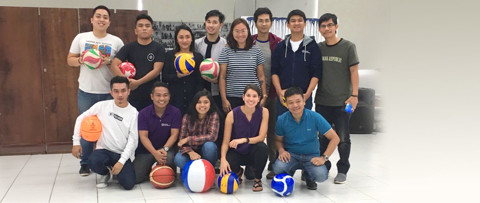
Children International team member Nadia Moreno (first row, second from right) poses with the global nonprofit’s Sport for Development training team in Manila, Philippines.
For Nadia Moreno, sports have always been more than a game – they’ve been a bridge.
Born in Maracaibo, Venezuela, Nadia moved to the United States in 1991, just as she reached school age. Like many children navigating a new country, she faced language barriers and the challenge of finding her place. Eventually, she found her footing, and it wasn’t in a classroom – it was on a field.
“I remember teachers taking us outside and just kicking a ball back and forth,” she recalls. “That’s how I started learning English. Through play. Through connection.”
That early experience not only shaped her childhood, but also her career.
Today, Nadia is helping design and lead programs – including team sports – that empower children and youth around the world to forge paths out of poverty.
As the Global Lead of Child and Youth Programs for the Kansas City-based Children International, her work helps young people in 10 countries build the confidence, skills and hope they need to thrive.
Indeed, says Nadia, the aspects of Children International’s programming that center on sports-based activities – and other forms of play – have a clear connection to success.
“People hear ‘sports’ and think of winning or losing,” Nadia says. “At Children International, we think about teamwork, communication and belonging.”
Indeed, at Children International, participating youth are learning essential life skills, such as cooperation, respect and problem-solving – skills they can carry into classrooms, relationships and future careers.
According to Nadia, the organization intentionally uses sports as a tool to engage children in deeper learning.
“When kids are playing, you already have their attention,” she explains. “That’s when you can start meaningful conversations – about friendships, challenges and even how to handle conflict.”
For many young people, these spaces offer something even more fundamental: the chance to simply be a child.
In the communities Children International serves, children and youth often carry responsibilities beyond their years – helping at home, caring for siblings or navigating difficult environments.
That’s why creating safe, supportive spaces matters.
“Some of the most powerful things I hear during site visits are kids saying, ‘This is where I can just be a kid,’” Nadia shares. “That’s incredibly meaningful.”
Through team sports and group activities, children form friendships, build confidence and begin to see themselves differently.
For some, it’s the first time they’ve stepped into a leadership role – choosing teams, guiding peers or simply feeling seen.
Nadia says she often hears from participants: “The fact that I can be part of this team makes me feel like I can be part of other things too.”
That sense of belonging can have a ripple effect – shaping how children show up in school, at home and in their communities.
While the activities may look like mere fun and games, Children International’s programs are designed to support development across multiple areas — from social and emotional growth to goalsetting and leadership.
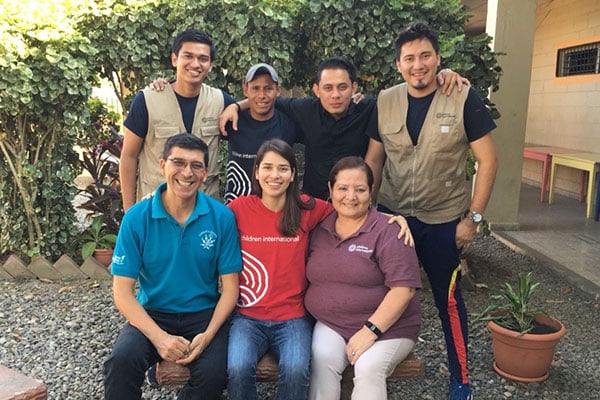
Nadia Moreno, Global Program Lead for Children International (center, in red shirt), during a visit with Children International’s Sport for Development team in Honduras.
Life skills like communication, teamwork and discipline are woven into every experience.
“These used to be called ‘soft skills,’ but they’re really essential skills,” Nadia says. “If you can’t communicate or work with others, it’s hard to succeed in any environment.”
And as the youths in Children International programs grow, those lessons expand into preparing for the future, from setting goals to exploring career paths.
In a world increasingly shaped by screens and digital interaction, Nadia sees play as more important than ever.
“Kids need spaces where they can connect face-to-face, be creative and build relationships,” she says. “That’s what play allows.”
Major global moments – like the upcoming FIFA World Cup games – offer an added opportunity to connect with youth through something they already love.
“These events bring people together,” Nadia says. “And for kids, they’re full of teachable moments about teamwork, resilience and what it means to be part of something bigger.”
For Nadia, sports-related activities and play are proven gamechangers.
From learning English on a playground to leading global programming, her journey reflects the very outcomes Children International strives to create.
“I’ve seen firsthand what a sports-based activity can do,” she says. “It builds confidence. It builds relationships. It helps kids believe in what’s possible.”
And sometimes, it starts with something as simple as a ball and a safe place to play.



Comments
kathyg123
Jun 2, 2026
I'm proud to be a part of My Sponsor Children's lives. One of my Sponsor Children (Nuris) is participating in Sports so I'm very proud that Nadia is encouraging All Children to participate in Sports, and see first hand that it builds confidence, and build relationships. I'm always excited to learn more about what Children International has to offer to All Children. I always look forward to hearing from my Sponsor Children, and Children International Staff. Thank you Children International for All You Do for Sponsors, and their Sponsor Children, and All Children waiting on a Sponsor. Happy 90th Anniversary Children International!
You must be logged in to comment. If you have an account, click here to log in.