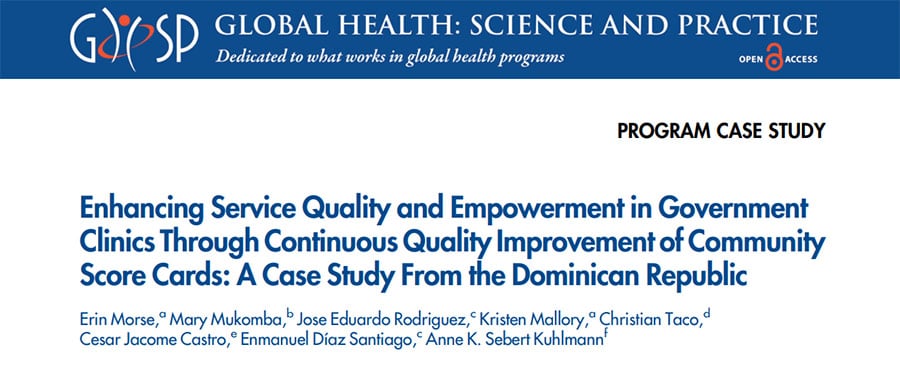
KANSAS CITY, Mo. (April 7, 2026) — Children International has published a case study about the importance of fostering accountability in global health care systems in the peer-reviewed journal Global Health: Science and Practice.
The journal article, authored by Children International and its academic partners, is titled “Enhancing Service Quality and Empowerment in Government Clinics Through Continuous Quality Improvement of Community Score Cards: A Case Study From the Dominican Republic.”
It details Children International’s work with 10 clinics from 2018 to 2023 to make services to more than 21,000 children and adults more responsive and people centered. It also highlights how a tool known as the Community Score Card enables community members and health care providers to assess public health services, joint action and hold each other accountable. This process has led to collaboration between community leaders, youth and health care staff to address problems such as cleanliness, wait times, medicine availability and staff attitude.
“This case study demonstrates how community-driven social accountability can empower communities and transform primary health care for children, youth and families,” said Erin Morse, lead author of the case study and senior program officer at Children International, a global nonprofit that works in 10 countries to end generational poverty.
Enmanuel Díaz Santiago, co-author of the study and a program manager at Children International Dominican Republic, agrees.
“Through the Community Score Card process, we saw communities move from disengagement to active ownership of their local health clinics,” he said. “Youth and adults became empowered to identify challenges, propose solutions and drive real improvements. Health care providers responded with renewed commitment and collaboration.”
Key findings from the study
“Using the Community Score Card toolkit for continuous quality improvement, our staff and community health partners in the Dominican Republic strengthened relationships between residents and clinics, amplified youth voices and generated actionable insights now applied across our health equity work,” Morse said.
Indeed, the Dominican Republic initiative has become a model for Children International’s broader health and social accountability efforts. The organization has implemented the Community Score Card approach in dozens of clinics in eight countries, helping make additional local health systems more responsive and effective.
The case study also offers information for community health practitioners and local governments interested in creating evidence that can be useful at the clinic or community level, while still informing national health policy.
To read the full case study, visit the Global Health: Science and Practice website.
Children International, based in Kansas City, Missouri, USA, is a global nonprofit that delivers child and youth development programming to break generational cycles of poverty. From childhood through young adulthood, Children International empowers young people in Colombia, Ecuador, the Dominican Republic, Honduras, India, Guatemala, Mexico, the Philippines, Zambia and the United States to forge a path out of poverty through access to health care, educational support, positive role models, and the life and job skills they need to become sustainably employed. When equipped to improve their own lives, young people also transform their families and communities, for generations to come. For more information, visit children.org.


Comments
You must be logged in to comment. If you have an account, click here to log in.